

Project list

DACH Innovation Evening Review | September 28, 2026 Keywords: Factory as Asset, spatial equation, factory as showroom, overseas super business card, listed companies, market value management
Throughout September, we explored "Factory as Asset" across four themes—value discovery, market value management, industrial tourism, and overseas expansion. Our month-end conclusion distills everything into three sentences: the factory is a listed company's most undervalued "second financial report"; the factory as showroom is manufacturing's most expensive billboard; and spatial standards are trust standards—a great factory is the ultimate calling card for going global.
With the National Day holiday approaching, it's the perfect time for entrepreneurs to step out of the office and into the factory. Before you do, these three sentences are worth thinking through.
Sentence One: The Factory Is a Listed Company's Most Undervalued "Second Financial Report"
Beyond the financial statements, listed companies keep a "spatial equation."
As securities analysts begin walking shop floors and institutional research moves from conference rooms to production lines, a factory's physical space is becoming part of the valuation logic. The spatial order of a factory holds information that financial reports don't directly state: whether management is disciplined, whether processes are mature, whether expansion is methodical.
Among DACH Innovation's clients—Wanhua Chemical, Dawn, Debon Technology, and Shida Shenghua in chemicals and advanced materials; Inovance Technology in industrial automation; Xinfengming in polyester filament; Finework in wind-power fasteners; Shangshui Intelligence in lithium-battery slurry equipment—these listed companies share one trait: their factory spaces are becoming physical texts through which investors read corporate strategy.
Take the chemicals belt stretching from Yantai to Weifang to Dongying. In this industry, safety trust and environmental-compliance audits are existential matters. A factory with clear planning, logical circulation, and professional visitor routes is itself the most direct proof of "safety governance capability." That proof cannot be written into an annual report or delivered in a roadshow—only space can present it directly.
This is the core logic of the spatial equation: factory space is the physical manifestation of strategic intent. Investors who can read space can read a company's certainty for the next three years.
Sentence Two: The Factory as Showroom Is Manufacturing's Most Expensive Billboard
Zhang Chi, founder of DACH Innovation—guest lecturer at Shanghai Jiao Tong University and Zhejiang University, and co-author of the smart-manufacturing bestseller Three-Body Intelligent Revolution—often says on project sites: "Your factory is your biggest billboard."
September's industrial-tourism theme validated this repeatedly. When dealers, investors, and government delegations walk through the same factory, the building must simultaneously host three kinds of "examiners." Luyuan's electric two-wheeler plant must win over channel partners; Shinva Medical's campus must earn hospital clients' trust; Kanion Pharmaceutical's transparent factory must answer consumers' questions about traditional Chinese medicine quality. Niche leaders like Haiyang Technology and Xingyu use factory space to prove their standing within foreign and joint-venture automotive supply chains.
For B2B companies, the biggest brand touchpoint isn't advertising—it's the factory itself.
The numbers don't lie: of DACH Innovation's 96 projects, 89.4% strictly follow an 11-step standardized process, and nearly half of clients chose integrated "architecture + interior + visualization" services. Why? Because more and more entrepreneurs realize that a 90-minute factory tour can determine an order more decisively than a year of advertising.
The essence of industrial tourism is converting "production cost" into "brand asset." A factory with zero-price admission that hosts tens of thousands of visitors annually—clients, students, suppliers, media—is no longer a cost center. It's a profit gateway.
Sentence Three: Spatial Standards Are Trust Standards—A Great Factory Is the Ultimate Calling Card for Going Global
In the final week of September, we wrote about overseas expansion. From Zhaolong Interconnect's Thailand plant to Runfeng's 50+ overseas subsidiaries and Argentina base, to a medical-device project in Kenya—Chinese companies going global have entered the "space going global" phase.

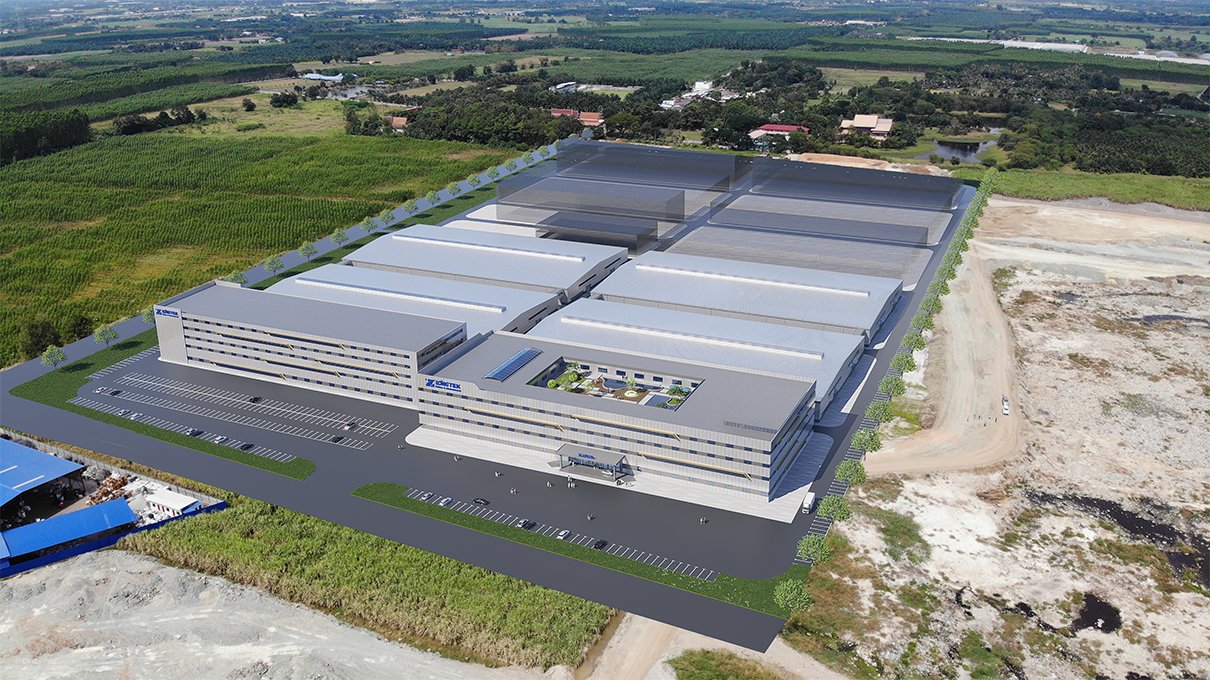
Overseas clients auditing your factory may not understand your process flow, but they can absolutely read your spatial order.
Thailand's BOI approvals, local employment ratios, international certification thresholds—behind these hard requirements lies a deeper test of "localized trust." Overseas pioneers like Geely Holding have long proven that an overseas factory is not just a production base but a brand embassy. And Japanese motor giant Nidec's choice to build a benchmark campus in Qingdao is reverse validation that factory-design capability grown on Chinese soil is now serving global enterprises.
DACH Innovation maintains offices in Frankfurt and Los Angeles, and our team has attended Hannover Messe for ten consecutive years. Our observation: as Chinese manufacturing shifts from "cost advantage" to "trust advantage," spatial design moves from bonus point to mandatory question.
A National Day Factory-Visit Guide: Three Questions to Test Your Factory
If you plan to walk your own factory or visit peers during the holiday, bring these three questions:
1.Investor's lens: If securities analysts came for research tomorrow, could my factory space tell a story beyond the financial statements?
2.Client's lens: If my most important client had only 90 minutes, what would my circulation route make them remember?
3.Employee's lens: If a talented post-95 engineer came for an interview, would this factory make them want to stay?
Three questions, three accounts: value, brand, talent. Their sum is the complete meaning of "Factory as Asset."
Closing: Onward in October
In September, 17 listed-company clients joined DACH Innovation in validating the "Factory as Asset" logic—from chemicals to lithium batteries, from medical devices to electric two-wheelers, from the Yangtze River Delta to Thailand, Kenya, and Argentina.
In October, we'll go deeper: field-level details of Lighthouse Factory evaluations, spatial solutions for zero-carbon campuses, and more real cases from the project frontline.
Factory as Asset. This is not a slogan—it's a value system that can be designed, verified, and replicated.
FAQ
Q: What exactly does "Factory as Asset" mean?
A: Factory space carries triple asset attributes—for investors, it's a physical text for value discovery (the spatial equation); for clients, it's a brand-trust touchpoint (factory as showroom); for overseas markets, it's a carrier of trust standards (the ultimate calling card). The factory transforms from cost center to value center.
Q: Which listed companies has DACH Innovation served?
A: Clients span chemicals/advanced materials, industrial automation, pharmaceuticals/medical devices, new-energy equipment, and synthetic fibers—including 17 listed companies such as Wanhua Chemical, Inovance Technology, Xinfengming, Zhaolong Interconnect, Luyuan Group, Kanion Pharmaceutical, Shinva Medical, Runfeng, Shangshui Intelligence, Haiyang Technology, and Xingyu—plus foreign enterprises like Japan's Nidec.
Q: What should you focus on when visiting factories during the National Day holiday?
A: Three dimensions—spatial order (management discipline), visitor circulation (brand narrative capability), and employee engagement (talent magnetism). A great factory lets investors read strategy, clients read trust, and talent read the future.
136-8169-0819

ARCHITECTURAL DESIGN