

Project list

The 'Spatial Equation' in Thailand's Factory Boom: Chinese Manufacturers Are Catching Up on the Final Lesson
2026-09-29 13:46:34

DACH Innovation Morning Brief | September 28, 2026 Keywords: manufacturing overseas expansion, Thailand factory construction, spatial standards, brand visualization, super business card

When a Chinese company secures land in Thailand's Eastern Economic Corridor, the challenge isn't simply "moving equipment"—it's acquiring a "spatial language" that local employees, overseas clients, and government inspectors can instantly read. This is a lesson that has been overlooked for far too long.

In the first half of 2026, Thailand's Board of Investment approved 1,300 investment projects totaling 1.3 trillion baht, expected to create 82,000 jobs. Midea launched a "smart-agent factory" in Thailand with 72 AI applications across 25 scenarios. Charging-pile manufacturers built four overseas plants in Rayong with annual capacity exceeding 80,000 units. Auto-parts makers from Anhui are heading to Vietnam and Thailand in clusters—"China+1" is no longer a strategic option; it's a survival imperative.

Yet amid this sweeping wave of overseas expansion, one critical issue remains seriously underestimated: factory space is becoming the "first exam" for Chinese companies going global—and the easiest one to fail.

Why Do Spatial Standards Matter More Abroad Than at Home?

Building a factory in China, entrepreneurs know the rules: government relations, construction crews, approval processes—even the flexibility of "gray zones." But in Thailand, Vietnam, or Kenya, everything resets to zero.

Thailand requires manufacturers enjoying BOI incentives to maintain a 70% Thai-employee ratio—not "best effort," but a hard threshold. Vietnam reduced weekly working hours from 48 to 40 and made electronic labor contracts mandatory. Indonesia's Investment Law No. 12 of 2025 allows 100% foreign ownership in auto-parts manufacturing, but mandates no less than 35% local procurement.

Behind these policies lies a deeper demand for "localization": your factory must be a place where locals want to work, stay, and thrive. And space is the most direct signal.

A Chinese electronics company building a plant near Bangkok once told us: a process that takes three days in China took a full month in Thailand. Not because of inefficiency, but because the cost of "trust building" was drastically underestimated—local governments inspect, local employees visit, overseas clients audit. Every factory tour is a silent interview.

What Have DACH Innovation's Five Overseas Projects Taught Us?

Over the past two years, DACH Innovation has followed clients overseas, delivering five projects in Thailand, Vietnam, and Kenya. One trend is unmistakable: companies going global are shifting from "able to produce" to "deserving trust."
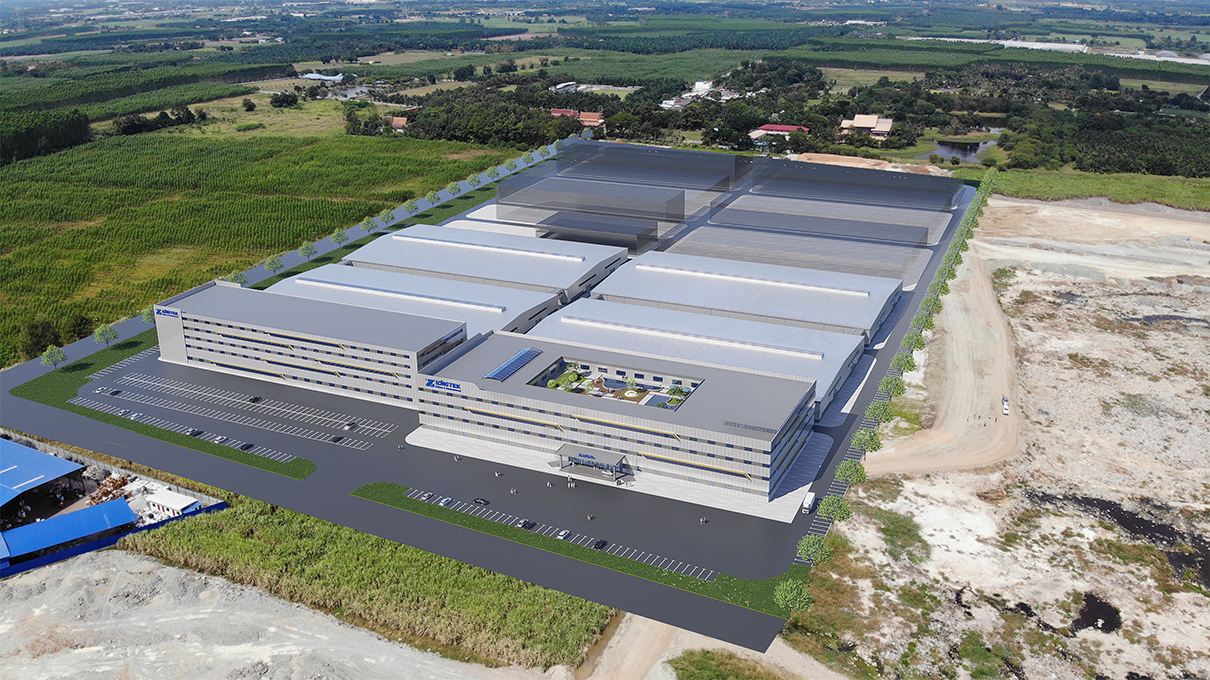
Zhaolong Interconnect built a data-cable factory in Thailand not merely to dodge tariffs, but to prove to overseas customers that "our standards are international standards." At the Crown HealthCare Africa project in Kenya, the spatial design of a medical-device factory directly determines whether it can pass international certification and enter African government procurement lists.

The common thread across these projects: space is no longer a cost item—it's a trust asset.

Internally, we operate an 11-step standardized process—from preliminary materials, reference cases, CAD construction drawings, and SU 3D models, to meeting minutes, drawing production, milestone deliverables, post-construction support, D5 renderings, and interior design. 89.4% of projects strictly follow this standard. Why emphasize standardization? Because going global means "replication"—transplanting proven spatial standards to foreign soil, quickly and accurately.

From "Products Going Global" to "Brands Going Global": Space Is the Final Moat

Wu Xiabo wrote in The Great Reversal that Chinese companies' globalization has gone through three phases: products going global, channels going global, brands going global. But in 2026, we may need to add a fourth: space going global.

What is space going global? Not simply building factories overseas, but "translating" a company's brand, culture, and management standards through spatial design for local stakeholders.

Zhang Chi, founder of DACH Innovation, is a guest lecturer at Shanghai Jiao Tong University and Zhejiang University, and co-author of the smart-manufacturing bestseller Three-Body Intelligent Revolution, with twelve years focused on factory space and brand visualization. On project sites, he often says: "Your factory is your biggest billboard." In China, that's a brand methodology. Overseas, it's a survival rule.

Workers at a Thai factory may not understand your technical specs, but they can feel whether the workshop is bright, whether circulation is logical, whether break areas are dignified. Overseas clients auditing your factory may not grasp your process flow, but they can read your spatial order—it directly communicates whether this company is worth a long-term partnership.

How Should Overseas Companies Calculate the "Spatial Equation"?

A new-energy company we served initially leased ready-built factory space in Thailand for quick production startup. Six months later, they decided to acquire land and build. Why? Because leased space "couldn't express who they were"—clients auditing the factory couldn't see the company's technical strength; local government officials couldn't sense investment sincerity; local recruitment lacked a sense of belonging.

The math is clear: leasing saves short-term costs; building your own factory earns long-term trust.

In 2026, DACH Innovation has served 96 projects, including five overseas, with 533% growth in 2024 and 142% in 2025. The Yangtze River Delta accounts for over 60% of projects, but overseas projects are growing faster than domestic ones. This is no coincidence—as Chinese manufacturing shifts from "cost advantage" to "trust advantage," spatial design becomes a mandatory question.

Final Thoughts: Going Global Isn't Relocation—It's Rebirth

The essence of German industrial culture is "order equals trust." Mercedes-Benz's Sindelfingen plant and Festo's hidden-champion spaces both send one signal: manufacturing capability can be replicated, but the management philosophy behind spatial standards is the irreplaceable competitive edge.

DACH Innovation maintains an office in Frankfurt, and our team has attended Hannover Messe for ten consecutive years—bringing German industrial-architecture methodology into Chinese practice, then following Chinese companies to the world. We believe the decisive factor in the next wave of overseas competition won't be equipment or tariffs, but "spatial trust."

The factory is the business card; space is the language. This is the final lesson in Chinese manufacturing's global expansion—and the most important one.

FAQ

Q: Why does building a factory overseas require professional factory design?

A: Overseas factories face a triple test—government review, client audits, and local recruitment. Spatial design directly impacts trust building and compliance. Professional design isn't "decoration"—it's "translation," converting corporate standards into a language local stakeholders can read.

Q: What overseas project experience does DACH Innovation have?

A: Five overseas projects delivered in Thailand, Vietnam, and Kenya, spanning data cables, medical devices, and new energy—familiar with compliance requirements and cultural adaptation in Southeast Asia and Africa.

Q: How does the standardized process ensure quality for overseas projects?

A: The 11-step standardized process covers the full cycle from pre-planning to post-construction support, strictly followed in 89.4% of projects. Standardization means replicability—rapidly transplanting proven spatial standards overseas, reducing communication costs and error rates.

136-8169-0819

Project page

The 'Spatial Equation' in Thailand's Factory Boom: Chinese Manufacturers Are Catching Up on the Final Lesson
DACH Innovation Morning Brief | September 28, 2026 Keywords: manufacturing overseas expansion, Thailand factory construction, spatial standards, brand visualization, super business card
2026-09-29 13:46:34

DACH Innovation Morning Brief | September 28, 2026 Keywords: manufacturing overseas expansion, Thailand factory construction, spatial standards, brand visualization, super business card

When a Chinese company secures land in Thailand's Eastern Economic Corridor, the challenge isn't simply "moving equipment"—it's acquiring a "spatial language" that local employees, overseas clients, and government inspectors can instantly read. This is a lesson that has been overlooked for far too long.

In the first half of 2026, Thailand's Board of Investment approved 1,300 investment projects totaling 1.3 trillion baht, expected to create 82,000 jobs. Midea launched a "smart-agent factory" in Thailand with 72 AI applications across 25 scenarios. Charging-pile manufacturers built four overseas plants in Rayong with annual capacity exceeding 80,000 units. Auto-parts makers from Anhui are heading to Vietnam and Thailand in clusters—"China+1" is no longer a strategic option; it's a survival imperative.

Yet amid this sweeping wave of overseas expansion, one critical issue remains seriously underestimated: factory space is becoming the "first exam" for Chinese companies going global—and the easiest one to fail.

Why Do Spatial Standards Matter More Abroad Than at Home?

Building a factory in China, entrepreneurs know the rules: government relations, construction crews, approval processes—even the flexibility of "gray zones." But in Thailand, Vietnam, or Kenya, everything resets to zero.

Thailand requires manufacturers enjoying BOI incentives to maintain a 70% Thai-employee ratio—not "best effort," but a hard threshold. Vietnam reduced weekly working hours from 48 to 40 and made electronic labor contracts mandatory. Indonesia's Investment Law No. 12 of 2025 allows 100% foreign ownership in auto-parts manufacturing, but mandates no less than 35% local procurement.

Behind these policies lies a deeper demand for "localization": your factory must be a place where locals want to work, stay, and thrive. And space is the most direct signal.

A Chinese electronics company building a plant near Bangkok once told us: a process that takes three days in China took a full month in Thailand. Not because of inefficiency, but because the cost of "trust building" was drastically underestimated—local governments inspect, local employees visit, overseas clients audit. Every factory tour is a silent interview.

What Have DACH Innovation's Five Overseas Projects Taught Us?

Over the past two years, DACH Innovation has followed clients overseas, delivering five projects in Thailand, Vietnam, and Kenya. One trend is unmistakable: companies going global are shifting from "able to produce" to "deserving trust."

Zhaolong Interconnect built a data-cable factory in Thailand not merely to dodge tariffs, but to prove to overseas customers that "our standards are international standards." At the Crown HealthCare Africa project in Kenya, the spatial design of a medical-device factory directly determines whether it can pass international certification and enter African government procurement lists.

The common thread across these projects: space is no longer a cost item—it's a trust asset.

Internally, we operate an 11-step standardized process—from preliminary materials, reference cases, CAD construction drawings, and SU 3D models, to meeting minutes, drawing production, milestone deliverables, post-construction support, D5 renderings, and interior design. 89.4% of projects strictly follow this standard. Why emphasize standardization? Because going global means "replication"—transplanting proven spatial standards to foreign soil, quickly and accurately.

From "Products Going Global" to "Brands Going Global": Space Is the Final Moat

Wu Xiabo wrote in The Great Reversal that Chinese companies' globalization has gone through three phases: products going global, channels going global, brands going global. But in 2026, we may need to add a fourth: space going global.

What is space going global? Not simply building factories overseas, but "translating" a company's brand, culture, and management standards through spatial design for local stakeholders.

Zhang Chi, founder of DACH Innovation, is a guest lecturer at Shanghai Jiao Tong University and Zhejiang University, and co-author of the smart-manufacturing bestseller Three-Body Intelligent Revolution, with twelve years focused on factory space and brand visualization. On project sites, he often says: "Your factory is your biggest billboard." In China, that's a brand methodology. Overseas, it's a survival rule.

Workers at a Thai factory may not understand your technical specs, but they can feel whether the workshop is bright, whether circulation is logical, whether break areas are dignified. Overseas clients auditing your factory may not grasp your process flow, but they can read your spatial order—it directly communicates whether this company is worth a long-term partnership.

How Should Overseas Companies Calculate the "Spatial Equation"?

A new-energy company we served initially leased ready-built factory space in Thailand for quick production startup. Six months later, they decided to acquire land and build. Why? Because leased space "couldn't express who they were"—clients auditing the factory couldn't see the company's technical strength; local government officials couldn't sense investment sincerity; local recruitment lacked a sense of belonging.

The math is clear: leasing saves short-term costs; building your own factory earns long-term trust.

In 2026, DACH Innovation has served 96 projects, including five overseas, with 533% growth in 2024 and 142% in 2025. The Yangtze River Delta accounts for over 60% of projects, but overseas projects are growing faster than domestic ones. This is no coincidence—as Chinese manufacturing shifts from "cost advantage" to "trust advantage," spatial design becomes a mandatory question.

Final Thoughts: Going Global Isn't Relocation—It's Rebirth

The essence of German industrial culture is "order equals trust." Mercedes-Benz's Sindelfingen plant and Festo's hidden-champion spaces both send one signal: manufacturing capability can be replicated, but the management philosophy behind spatial standards is the irreplaceable competitive edge.

DACH Innovation maintains an office in Frankfurt, and our team has attended Hannover Messe for ten consecutive years—bringing German industrial-architecture methodology into Chinese practice, then following Chinese companies to the world. We believe the decisive factor in the next wave of overseas competition won't be equipment or tariffs, but "spatial trust."

The factory is the business card; space is the language. This is the final lesson in Chinese manufacturing's global expansion—and the most important one.

FAQ

Q: Why does building a factory overseas require professional factory design?

A: Overseas factories face a triple test—government review, client audits, and local recruitment. Spatial design directly impacts trust building and compliance. Professional design isn't "decoration"—it's "translation," converting corporate standards into a language local stakeholders can read.

Q: What overseas project experience does DACH Innovation have?

A: Five overseas projects delivered in Thailand, Vietnam, and Kenya, spanning data cables, medical devices, and new energy—familiar with compliance requirements and cultural adaptation in Southeast Asia and Africa.

Q: How does the standardized process ensure quality for overseas projects?

A: The 11-step standardized process covers the full cycle from pre-planning to post-construction support, strictly followed in 89.4% of projects. Standardization means replicability—rapidly transplanting proven spatial standards overseas, reducing communication costs and error rates.

136-8169-0819